Indemnity Clauses in Contracts
📄Upload your contract for free to automatically review and negotiate terms like indemnity — powered by Gerri, the AI agent for redlines. 📃
What is an indemnity clause?
An indemnity clause is a contractual promise by one company to pay for certain kinds of losses experienced by the other company that result from a lawsuit, generally one filed by a third party.
What indemnity terms do most contracts have?
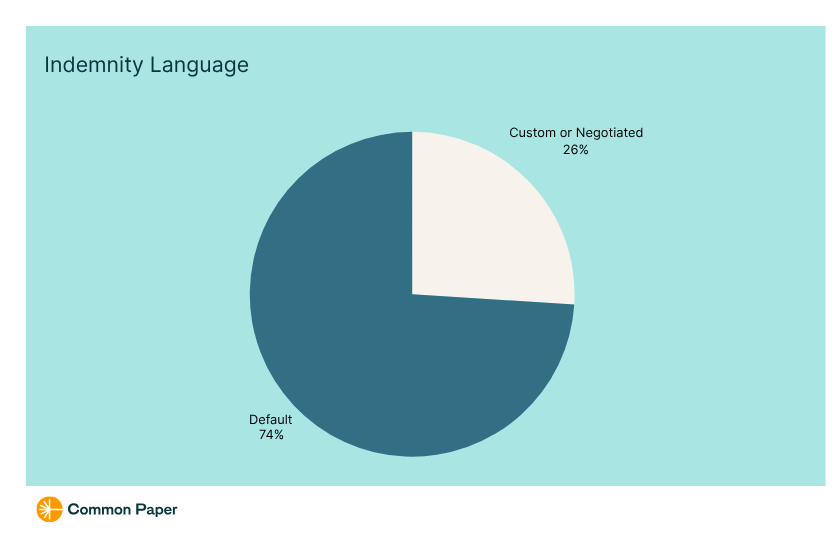
Based on data from more than 10,000 contracts:
When creating the Cloud Service Agreement, the Common Paper Committee decided to include the following covered (or indemnified) claims for providers and customers as the default: The provider will pay for the customer’s losses caused by a lawsuit about the product violating a third party’s intellectual property rights. The customer will pay for the provider’s losses caused by: A lawsuit about the content they uploaded to the product violating a third party’s intellectual property rights. A lawsuit about the customer breaching the restrictions of using the product, such as using it for an illegal purpose. 76% of CSAs included these default positions on covered claims.
Example indemnity language
Sample language from the Common Paper standard Cloud Service Agreement:
Protection by Provider. Provider will indemnify, defend, and hold harmless Customer from and against all Provider Covered Claims made by someone other than Customer, Customer’s Affiliates, or Users, and all out-of-pocket damages, awards, settlements, costs, and expenses, including reasonable attorneys’ fees and other legal expenses, that arise from the Provider Covered Claims.
Protection by Customer. Customer will indemnify, defend, and hold harmless Provider from and against all Customer Covered Claims made by someone other than Provider or its Affiliates, and all out-of-pocket damages, awards, settlements, costs, and expenses, including reasonable attorneys’ fees and other legal expenses, that arise from the Customer Covered Claims.
“Provider Covered Claims” means any action, proceeding, or claim that the Cloud Service, when used by Customer according to the terms of the Agreement, violates, misappropriates, or otherwise infringes upon anyone else’s intellectual property or other proprietary rights.
“Customer Covered Claims” means any action, proceeding, or claim that (1) the Customer Content, when used according to the terms of the Agreement, violates, misappropriates, or otherwise infringes upon anyone else’s intellectual property or other proprietary rights; or (2) results from Customer’s breach or alleged breach of Section 2.1 (Restrictions on Customer).
Sample language for exclusions to Indemnity obligations:
Exclusions.
Provider’s obligations as an Indemnifying Party will not apply to Provider Covered Claims that result from (i) modifications to the Product that were not authorized by Provider or that were made in compliance with Customer’s instructions; (ii) unauthorized use of the Product, including use in violation of this Agreement; (iii) use of the Product in combination with items not provided by Provider; or (iv) use of an old version of the Product where a newer release would avoid the Provider Covered Claim.
Customer’s obligations as an Indemnifying Party will not apply to Customer Covered Claims that result from the unauthorized use of the Customer Content, including use in violation of this Agreement.
Risks to watch for in indemnity clauses
| ⚠️ Risk | Description |
|---|---|
| 🚨 Broad Indemnity Clauses | Counterparties may shift excessive liability to you—covering issues beyond your control or unrelated to the product. |
| 🧾 Uncapped Exposure | Without clear limits, indemnification obligations can leave you responsible for unlimited legal and financial risks. |
| 🔎 Vague Exclusions | Exclusions that are too narrow could leave the indemnifying party with unintentionally broad obligations, while exclusions that are too expansive could gut the indemnity obligation entirely. |
How Gerri, the AI Agent for redlines, can help
- 📤 Reviews uploaded or emailed contracts
- ⚠️ Proposes redlines based on your team’s specific policies and positions
- ✅ Understands the context and explains decisions
- 📄 Outputs a ready-to-send document for your counterparty to review
- ⏰ Saves 80% of legal review time and accelerates sales cycles